
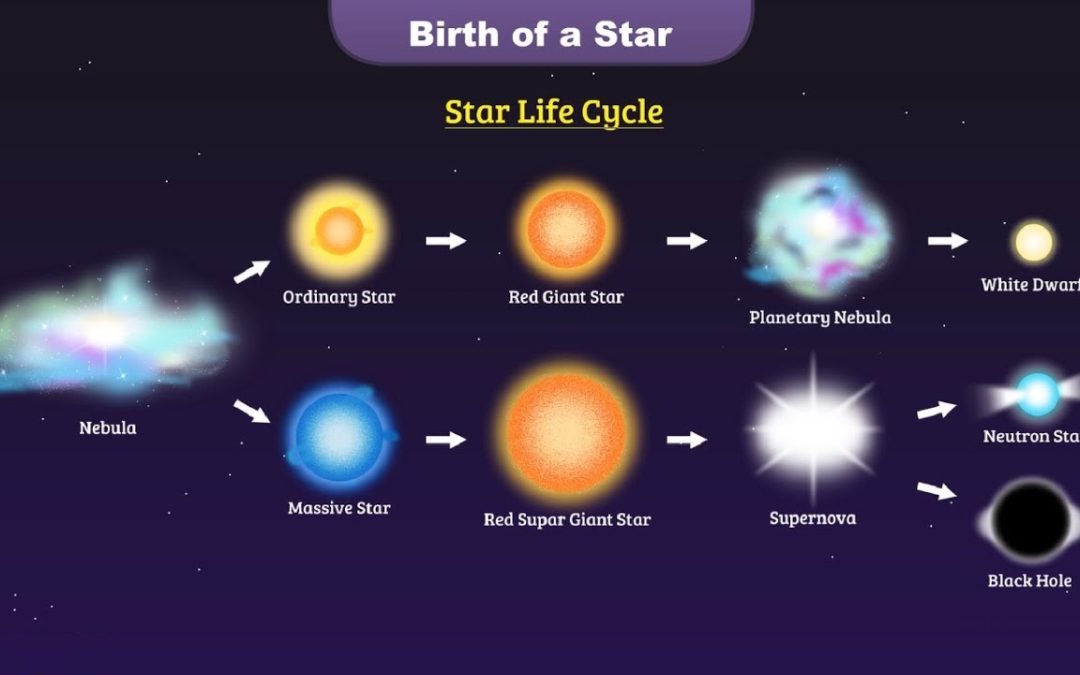
How Stars Are Born: From Cosmic Gas to Shining Sun
The birth of a star is one of the most fascinating processes in the universe. It begins with a giant cloud of gas and dust, called a molecular cloud, slowly collapsing under its own gravity. As the cloud collapses, it spins faster and forms a disk of material around a central point.
Inside this disk, gas and dust clump together and heat up, eventually forming a protostar. Over time, the temperature and pressure at the protostar’s core rise. When they reach a critical level, nuclear fusion ignites, turning the protostar into a shining star. The fusion process releases enormous energy in the form of light and heat, which stabilizes the star and prevents it from collapsing further.
Star formation is a slow process, taking millions of years. Different regions of the molecular cloud collapse at different rates, which can lead to multiple stars forming in a single system. The size, mass, and collapse rate of the molecular cloud influence the final properties of the star, such as its size, mass, temperature, and lifespan.
Star Formation Since the Big Bang
After the Big Bang, the universe was incredibly hot. Within just a few minutes, temperatures dropped from unimaginably high numbers to about 1 billion degrees Celsius, allowing the first light elements—hydrogen, helium, and lithium—to form.
For the first 2.1 billion years, no stars existed. Only cosmic gases floated through space. Modern simulations show that gravity caused these gases to clump together, forming dense regions that heated up to about 1,000°C. Hydrogen atoms combined to form molecules, which cooled the densest parts of the cloud to near 0°C, creating massive dark nebulae—invisible in ordinary light but detectable with infrared or radio telescopes.
These dense regions of gas eventually collapsed further, forming protostars. Early protostars were monstrously massive, sometimes over 10,000 times the mass of the Sun. Over about one million years, these protostars evolved into young stars.
The Protostar Phase
As a protostar forms, the surrounding gas radiates infrared energy, cooling the core and increasing its density. Multiple protostars can form in a single gas cloud, each with its own gravity that pulls in surrounding gas.
When the core temperature rises to thousands of degrees, the protostar emits infrared radiation. Eventually, thermonuclear fusion begins, creating a stable star. The protostar’s mass stabilizes, and it becomes a young star ready to shine.
During this phase, called the T-Tauri phase, the young star emits strong interstellar storms, ejecting gas from its poles. A rotating disk of gas forms around the star, which later coalesces to form planets. During this stage, the star may lose up to 50% of its mass before stabilizing.
From Young Star to Mature Star
Stars start relatively cool, but as fusion continues, their temperature rises, and they take on a bluish-white hue. The speed of this process depends on the star’s initial mass. Massive stars evolve quickly, while smaller stars take longer to mature.
The surrounding nebulae, full of gas and dust, are often colorful due to various elements. These stellar nurseries are where the life cycle of stars continues.
Summary
The formation of a star is a complex, multi-step process:
-
Collapse of a molecular cloud under gravity.
-
Formation of a spinning disk and clumping of gas and dust.
-
Creation of a protostar as the core heats up.
-
Initiation of nuclear fusion stabilizes the star.
-
The young star enters the T-Tauri phase, losing mass and forming a planetary disk.
-
The star eventually becomes mature, shining steadily for millions to billions of years.
Star birth is slow, uneven, and influenced by the mass and size of the original gas cloud. Each star’s life and properties are shaped by these initial conditions, creating the diverse stellar population we see in the universe today.
Please follow us on social media: Facebook, Instagram, LinkedIn, Twitter, Tumblr, and Reddit. Don’t forget to like and subscribe to our YouTube channel.