
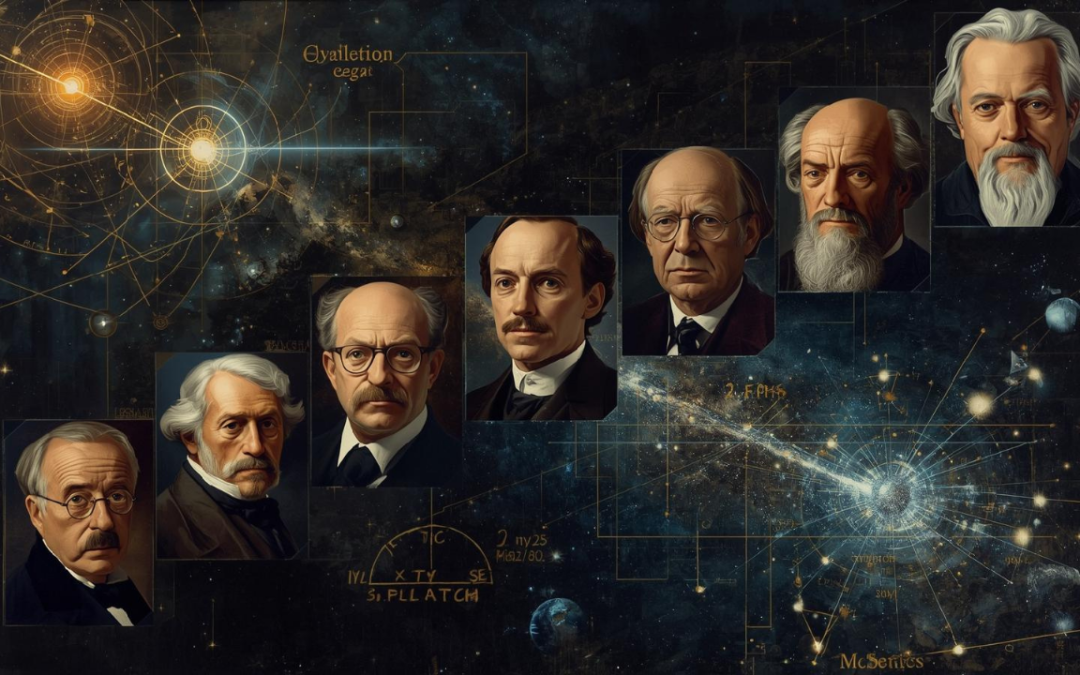
Introduction to Quantum Mechanics
Quantum mechanics is a fundamental branch of physics. It explains how matter and energy behave at tiny scales, such as atoms and subatomic particles. Unlike classical physics, quantum mechanics reveals a world that is probabilistic, surprising, and often counterintuitive.
This theory has transformed modern science and technology. In this article, we examine the origins and development of quantum mechanics and its profound impact on our understanding of the universe.
The Beginning of Quantum Theory (1900)
The story of quantum mechanics began in 1900 with physicist Max Planck. He discovered that energy is not continuous. Instead, it comes in small, discrete units called quanta.
This idea, known as energy quantization, challenged classical physics and laid the foundation for quantum theory.
Einstein and the Nature of Light (1905)
In 1905, Albert Einstein expanded on Planck’s idea. He proposed that light also behaves as particles, later called photons.
Einstein’s work introduced the concept of wave-particle duality, showing that light can act both as a wave and as a particle. This breakthrough became a core principle of quantum mechanics.
Bohr’s Atomic Model (1913)
In 1913, Niels Bohr introduced a new model of the atom based on quantum ideas. He suggested that electrons move in fixed energy levels around the nucleus.
Bohr’s atomic theory successfully explained why atoms emit light at specific wavelengths. This was a major step forward in understanding atomic structure.
Schrödinger and the Wave Equation (1926)
The mathematical foundation of quantum mechanics was established in 1926 by Erwin Schrödinger. He developed the Schrödinger equation, which describes how quantum systems change over time.
This equation is still one of the most important tools in quantum physics today.
Heisenberg’s Uncertainty Principle (1927)
In 1927, Werner Heisenberg introduced the uncertainty principle. It states that you cannot precisely measure both the position and momentum of a particle at the same time.
This principle shows that uncertainty is a fundamental part of nature, not a limitation of measurement tools.
The Copenhagen Interpretation
During the 1920s, Bohr and Heisenberg developed the Copenhagen interpretation of quantum mechanics.
According to this view:
-
Particles exist as probabilities.
-
The wave function collapses when observed.
-
Measurement affects the outcome.
This interpretation remains one of the most widely accepted explanations of quantum behavior.
Expansion in the 1930s and Beyond
In the 1930s, quantum mechanics was applied to subatomic particles and their interactions. This led to:
-
The discovery of new particles
-
Advances in nuclear and particle physics
-
The foundation of quantum field theory
Quantum mechanics became essential to modern physics.
Modern Applications of Quantum Mechanics
Today, quantum mechanics plays a critical role in many fields, including:
-
Quantum chemistry
-
Condensed matter physics
-
Semiconductor technology
-
Lasers and medical imaging
-
Quantum computing
Many technologies we use daily exist because of quantum theory.
Conclusion
The birth and evolution of quantum mechanics mark one of the greatest achievements in science. From Planck’s early discoveries to modern applications, quantum mechanics has reshaped how we understand reality.
Even today, it continues to drive innovation and deepen our knowledge of the universe at its most fundamental level.
Follow us on Facebook and don’t forget to like it and subscribe to our YouTube channel.