
Increase views on YouTube videos! Here some effective ways.
There’s no one-fits-all answer to this question. The number of views your YouTube videos get will depend on various factors such as the topic, production value, length, and promotion. But by upping your views, you can also increase your chances of being discovered by new viewers, which is essential for growing your channel and making money on YouTube. Having said that, you can do a few things to increase your chances of getting more views. Here are some actionable tips:How can you Increase Views on your YouTube Channel?
1. Write Attention-Grabbing Titles to Increase Views
No, we’re not encouraging you to write clickbait. Instead, focus on creating titles that accurately reflect the content of your video while being creative and interesting enough to make people want to click. Your title should give viewers a general idea of the video. At the same time, it should be short, sweet, and to the point. Make sure to include relevant keywords that people might search for on YouTube. It will help your video come up on search results. Dr. Mike does a great job of this. His video titles are to the point and self-explanatory.2. Add a Custom Thumbnail
Adding a custom thumbnail can help increase your click-through rate and, as a result, get more views. Thumbnails are little images that give viewers a preview of your video. By default, YouTube generates random thumbnails for you to choose from. But we recommend you upload a custom thumbnail to make your video look more professional and trustworthy. When creating a thumbnail, ensure it’s high quality and relevant to the video. Most importantly, it should be enticing enough to make viewers want to click. Take a page out of Mr. Beast’s book.3. Create Playlists
YouTube playlists are a great way to keep your viewers engaged with your channel while allowing them to explore new content. You can create a playlist for almost anything, whether a group of your favorite songs, a compilation of videos from a specific theme, or a series of how-to guides.4. Use End Screens to Increase Views
Another way to get more views on your YouTube videos is to add an End Screen. An End Screen is a YouTube feature that allows you to promote other content on your channel and external websites in the last few seconds of your video. You can use an End Screen to promote up to four videos, playlists, or channels on YouTube or link to an approved website. You can also encourage viewers to subscribe to your channel and link to your merchandise. Firstly, it’s essential to verify your account.
Is your youtube channel verified to Increase Views?
5. Ask Your Audience
There’s no better way to get more views on your YouTube videos than to ask your audience what they want to watch. For example, if you have a tech channel, you can ask your audience what devices or software they want you to review. If you have a cooking channel, you can ask your audience for recipe ideas or fun YouTube challenges. The key is to be responsive to your audience’s suggestions and give them the content they want. You can use YouTube’s Community tab to ask your audience questions or ask them in the video itself. Either way, ensure you’re regularly asking your audience what they want to see and then delivering their desired content. You can also use social media for this. For example, put up a question tab on your Instagram story and ask your followers what type of videos they want to see. You can also use Twitter or Facebook polls. On the one hand, your audience’s feedback helps you set SMART digital marketing goals. On the other hand, it increases views because the audience is getting what they asked for.6. Enable Embedding to Increase Views
When you enable embedding on your YouTube videos, your viewers can choose to embed your videos on other websites. It lets you increase the reach of your videos and helps promote your YouTube channel. Here’s how to enable embedding:- Go to Creator Studio.
- Go to the edit page for the video.
- In Advanced Setting, go to Distribution options and tick Allow Embedding.
7. Tap Into Influencer Marketing to Increase Views
Earth Web data revealed there are 3.2 to 37.8 million influencers worldwide, spread across YouTube, TikTok, and Instagram. That explains the increasing trend of influencer marketing, especially on social media. You can create an influencer strategy to get more views on your YouTube videos. Here’s how to do it.- Suppose you’re a lifestyle brand selling fashion and home decor products. You want your YouTube channel to come to life.
- Your first step is to identify the right influencers. Let’s say you’ve decided to work with three influencers with 50,000 and 100,000 followers. Or, you can work with micro-influencers to reach the niche market.
- Your next step is to contact the influencers and pitch your idea. You can offer to pay them or give some other compensation, such as free products or services.
- These influencers can post about you on their social media channels, such as Instagram and TikTok. For example, they can link to your affiliate videos in their Instagram stories.
- In this way, their followers will become aware of your channel and watch your videos. You can also ask the influencers to mention you in their YouTube videos.
8. Follow the Best YouTube SEO Practices to Increase Views
You’ll only get more views if you appear at the top of the search results. To accomplish that, you need to step up your YouTube SEO game. Here are a few good practices:- Keywords in Titles and Descriptions: When people come to YouTube, they enter keywords, or phrases, to find the videos they’re looking for. You want your video to show up when those keywords are entered. So put them in your title and description. Keywordtool.io & Tube Buddy is an excellent tools to help you find the right keywords for your videos.
- Annotations: You can add notes to your videos that pop up at certain times. These can help guide viewers to take specific actions, like subscribing to your channel or checking out your website.
- Thumbnails: The thumbnail is the first thing people see when they come across your video in the search results. So make sure it’s something eye-catching that accurately represents what the video is about.
- Tags: Tags are like keywords for your videos. They help YouTube understand what your video is about, and they can also help it show up in the search results.
9. Partner With Other YouTubers
Guest appearances, mash-ups, and interviews with other creators are great ways to get more views and subscribers on YouTube. Collaborating with other YouTubers can help you tap into new audiences and gain exposure for your channel. For example, if you make commentary videos about pop culture, consider reaching out to a YouTuber who creates similar content and see if they’d be interested in doing a crossover video with you. You can also do a guest appearance on another channel or have another YouTuber interview you for their show. For instance, Brand Mondo, a hair stylist, and Dr. Mike did a crossover. Dr. Mike posted the following video on his channel while Mondo helped him choose outfits. Likewise, Mondo also posted a video on his channel where Dr. Mike explains how to cure dry scalp and dandruff. As evident, the video content was relevant to each creator’s specific audience.10. Host a Giveaway
What could be better than getting free stuff? Hosting a giveaway can bring in more viewers for your YouTube videos. It’s a great way to engage with your audience and get them involved in your content. Give away something that resonates with your brand and brings you closer to your audience. If you are a vlogger who consistently gets questions on the type of camera that you use or how to set your lighting up, consider giving away a content creator kit with your best goodies. You can keep rules as simple as liking a video, leaving a comment, and subscribing to your channel. Alternatively, you can make the entry requirements exciting by coming up with creative challenges for your viewers to complete. Make sure to promote your giveaway across social media platforms to get as many people involved as possible. You can also partner with other YouTubers who have a similar audience to yours to help reach more people.11. Optimize Your Channel
Optimizing your YouTube channel is instrumental to its success. You can’t have incomplete information or a poor design and expect to draw in viewers and keep them engaged. Here are some tips for optimizing your channel:- If you’re a company or brand, make sure your profile picture is your logo.
- Set a relevant banner image that shows your latest campaign, product, or event. It should be a minimum of 2560 x 1440 pixels. Even non-designers can do wonders with the tools available today.
- Have a description that’s keyword rich and tells viewers what they can expect from your channel. YouTube has a 1000-character limit, so use it wisely. Incorporate keywords and keep the description to the point.
- Add links to your social media channels and website.
12. Choose the Right Time to Publish
Fortunately, YouTube now gives you a “When your viewers are on YouTube” report in your Analytics that tells you when your viewers are watching YouTube. With this information, you know when is the best time to publish your video. Make sure you publish videos when your viewers are most active to maximize your chances of being seen.13. Transcribe Your YouTube Videos
You might be losing out on view because of language constraints or disabilities. The best solution is to transcribe your videos. You can use a tool like oTranscribe, a free and open-source web app, to transcribe your videos. Or, you can hire transcription professionals from sites like Fiverr and Upwork for increased accuracy.Final Words
As evident, there are several ways to increase views on your YouTube channel. You should also promote your content on other social media platforms. Additionally, you can work with influencers and create playlists to grow your online presence. Plus, engage your audience, encourage them to subscribe to your channel, partner with other content creators, and create SEO-friendly titles and tags.Easy Ways to Increase Views On YouTube Videos
How can you Increase Views on your YouTube Channel?
There’s no one-fits-all answer to this question. The number of views your YouTube videos get will depend on various factors such as the topic, production value, length, and promotion. But by upping your views, you can also increase your chances of being discovered by new viewers, which is essential for growing your channel and making money on YouTube. Having said that, you can do a few things to increase your chances of getting more views. Here are some actionable tips:To increase your YouTube video views legitimately, first and foremost, you’ll have to brush up on your YouTube SEO practices. This means:
- Knowing which keywords to use. Keywords are people’s search phrases and queries. If you want your video to be discoverable, you’ll have to use the right keywords. Opt for long-tail (meaning, more descriptive and accurate) keywords, since they are easier to rank for. The broader your keyword is, the harder it is going to be to rank for it. For example, instead of trying to rank for “cute dogs”, try to rank for “cute dogs doing silly things”.
- Optimizing Your Video Titles. YouTube cuts video titles off at 66 characters, so make sure your titles are shorter than that and are concise. If your audience can see what your video will be about, they are more likely to click on it.
- Optimize Your Thumbnails. This is very, very important. Make sure your thumbnails are clear and appealing. Also, your thumbnails should complement your video title - so make sure they go together well.
- Optimize Your Video Descriptions. Your video description is prime real estate for using keywords. Make sure you insert your keywords at the beginning of the description and up to 3 other times throughout and write for people. Give a description of your video using proper language and writing rules - don’t just type out your keywords over and over again because that’s not going to fly with YouTube’s algorithm.
- Create Playlists. YouTube is likely to recommend other videos from your playlists, and curating your content will make viewing it a much more pleasant experience for your viewers.
• By investing some money
• Without investing any money
By paid methods, you can run ads on Facebook, Instagram, and Google AdWords— these will automatically boost your ad by increasing the views, and if the audience like your content then they will surely subscribe to your channel. You should run ads on your best video which you think that this video can grow more in the future and you can add your success stories on ads you can also promote your channel by giving money to other successful YouTubers to promote your channel And also there are other paid methods you can apply to grow.
But if you don't want to invest any money to Increase Views, in that case, ????????
• Let's be more focussed on every social media platform like Linkedin, Facebook, Instagram, etc to grow your followers or network there. Put stories, posts, etc there related to your content daily and consistently.
• And upload more and more videos on daily basis.
• Focus on your content to Increase Views— how good it is. Try to improve it. For example, if your channel is based on teaching then watch other top YouTubers' videos to improve your videos.
• Focus on your thumbnail to Increase Views, it should be very attractive and with some hidden concept in it that people should click on it. Try to improve your video editing because good and attractive editing can boost your channel's views very fast. Make shorts as much as possible Because it can increase your subscribers. YouTube virals the shorts very fast, you just focus on your content.
JUST REMEMBER THIS …You Can Definitely Do it!!!!! Don't GIVE UP By Uploading Only some Videos and then Quit. Then you cannot grow there.
The next thing you’ll have to do is be consistent with your uploading schedule and promote your videos on other social media networks and platforms. This will keep your followers on all social media outlets notified whenever you upload new content and they’ll be sure to watch it.
Final Words
As evident, there are several ways to increase views on your YouTube channel. You should also promote your content on other social media platforms. Additionally, you can work with influencers and create playlists to grow your online presence. Plus, engage your audience, encourage them to subscribe to your channel, partner with other content creators, and create SEO-friendly titles and tags. Read More:Shark Mystery: 15 rare shark in the oceans
The ocean is deep and strange and sometimes full of teeth. We've all heard of Jaws, the most famous great white shark in history. But did you know there are around 500 species of shark and that some of them are either rare, super weird or both? From the ancient monster with a mouse like a buzzsaw to the modern era giant which lives more than 500 years here's the 15 most rare shark species hidden in the ocean.01: helicopteron shark.
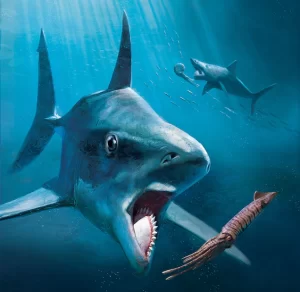 The helicopteron is one massive predator that we no longer have to worry about while out doing a little swimming in the coastal waters.This giant went extinct around 250,000,000 years ago.The fossil records, including some important recent discoveries, have allowed scientists to put together a fascinating picture of the helicopteron.
An example found in Idaho led to researchers concluding that the huge fish could grow to as much as 40ft or 12 meters. That's twice the size of the great white.
Another fascinating aspect of the helicopter is the formation of its teeth and jaw.And it's just this which has given it the nickname the buzzsaw shark.
The wall of teeth resembling a buzzsaw was a mystery for many years as attempts were made to construct the creature from these few remains and the wall was placed in a variety of positions on the fish's body before, finally, in 2013, they decided once and for all. It was a bizarre protrusion from the lower jaw which allowed this species to catch and eat prey more easily.
Furthermore, they were able to conclude that the helicopter was a kind of ratfish rather than a shark although they are close relatives. But this rat shark monster, whatever it was turns out to have been the biggest and most successful predator of the during its lifetime as well as one crazy looking fish.
The helicopteron is one massive predator that we no longer have to worry about while out doing a little swimming in the coastal waters.This giant went extinct around 250,000,000 years ago.The fossil records, including some important recent discoveries, have allowed scientists to put together a fascinating picture of the helicopteron.
An example found in Idaho led to researchers concluding that the huge fish could grow to as much as 40ft or 12 meters. That's twice the size of the great white.
Another fascinating aspect of the helicopter is the formation of its teeth and jaw.And it's just this which has given it the nickname the buzzsaw shark.
The wall of teeth resembling a buzzsaw was a mystery for many years as attempts were made to construct the creature from these few remains and the wall was placed in a variety of positions on the fish's body before, finally, in 2013, they decided once and for all. It was a bizarre protrusion from the lower jaw which allowed this species to catch and eat prey more easily.
Furthermore, they were able to conclude that the helicopter was a kind of ratfish rather than a shark although they are close relatives. But this rat shark monster, whatever it was turns out to have been the biggest and most successful predator of the during its lifetime as well as one crazy looking fish.
02: Greenland shark.
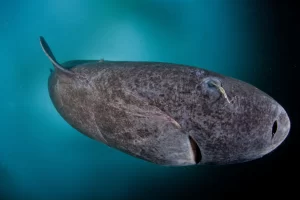 Here's another pretty damn huge fish the Greenland shark. Although modern sharks can't compete to their ancient ancestors in terms of size, these sharks, who mainly inhabit the waters of the North Atlantic Ocean, can still grow to around around 22ft or 7 meters in length. The average size of a mature adult is more like 13ft or 4 meters.
And this full size is achieved at around age 150. That's right. These sharks only reach adulthood at 150 years old. That means that parent Greenland sharks today have had to put up with teenagers since the American Civil War. 4.9s In fact, radiocarbon dating from the eye lenses of some individuals has placed their age at least 500 years old. That makes this the oldest vertebrate species on Earth.
Think about that. There are sharks in our seas right now who were born at a time when King Henry VIII was on the throne of England and the Spanish were still at war with the Aztecs in Mexico.
Although the Greenland sharks live far from humans, they are now a near threatened species, often accidentally caught in trawler nets. Let's hope these sharks get the chance to fulfill their incredible longevity more often.
Here's another pretty damn huge fish the Greenland shark. Although modern sharks can't compete to their ancient ancestors in terms of size, these sharks, who mainly inhabit the waters of the North Atlantic Ocean, can still grow to around around 22ft or 7 meters in length. The average size of a mature adult is more like 13ft or 4 meters.
And this full size is achieved at around age 150. That's right. These sharks only reach adulthood at 150 years old. That means that parent Greenland sharks today have had to put up with teenagers since the American Civil War. 4.9s In fact, radiocarbon dating from the eye lenses of some individuals has placed their age at least 500 years old. That makes this the oldest vertebrate species on Earth.
Think about that. There are sharks in our seas right now who were born at a time when King Henry VIII was on the throne of England and the Spanish were still at war with the Aztecs in Mexico.
Although the Greenland sharks live far from humans, they are now a near threatened species, often accidentally caught in trawler nets. Let's hope these sharks get the chance to fulfill their incredible longevity more often.
03: whale shark.
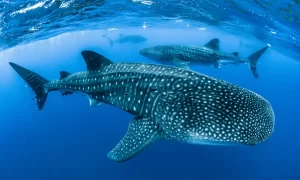 Keeping on the theme of huge size, here S, a champion fish, the largest fish in the world still alive today, the whale shark.
The name might be confusing to some, but these giants are definitely sharks and not mammals, although some of their behavior can resemble that of whales. For a start, their size is certainly whalelike, and they tend to grow to around 40ft or 12 meters in length, which is as long as a school bus, and their mouths are around 5ft or one 5 meters wide.
These huge mouths help whale sharks with filter feeding. This pretty much means opening that face hole as wide as possible and letting water pass through the body with internal organs, picking up any morsels of food. This makes whale sharks a little less aggressive than their predatory cousins.
Whale sharks can live pretty much anywhere in the world where the waters don't get too cold, and they seem to particularly enjoy the Red Sea, where the normally solitary creatures sometimes gather to feed.
These sharks live a pretty long time, too, up to 150 years, although the chances of seeing one in the wild are pretty slim these days, with their population declining by almost 65% since the 1950s, making these spectacular giants both fascinating and extremely rare.
Keeping on the theme of huge size, here S, a champion fish, the largest fish in the world still alive today, the whale shark.
The name might be confusing to some, but these giants are definitely sharks and not mammals, although some of their behavior can resemble that of whales. For a start, their size is certainly whalelike, and they tend to grow to around 40ft or 12 meters in length, which is as long as a school bus, and their mouths are around 5ft or one 5 meters wide.
These huge mouths help whale sharks with filter feeding. This pretty much means opening that face hole as wide as possible and letting water pass through the body with internal organs, picking up any morsels of food. This makes whale sharks a little less aggressive than their predatory cousins.
Whale sharks can live pretty much anywhere in the world where the waters don't get too cold, and they seem to particularly enjoy the Red Sea, where the normally solitary creatures sometimes gather to feed.
These sharks live a pretty long time, too, up to 150 years, although the chances of seeing one in the wild are pretty slim these days, with their population declining by almost 65% since the 1950s, making these spectacular giants both fascinating and extremely rare.
04: Megamouth shark.
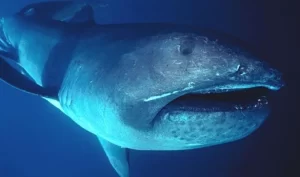 The megamouth shark. Can you see where this one is going? There's a clue in the name right there.
This shark has, you guessed it, a really big mouth. Similar to the whale shark, the Megamouth is a filter feeder, and in fact, the two species are closely related, with the Megamouth being a little smaller.
However, that mouth is up there with the best of them, giving it a characteristic gaping look, which, while kind of terrifying, is only designed to catch small stuff.
Where the Megamouth stands out is its incredible rarity. These sharks are so mysterious, we hardly know anything about them. And in spite of its size, we only discovered their existence as recently as 1976. Overall sightings amount to barely 60 encounters.
Since these giants prefer to live in the deepest oceans without increased trawling of the deep seas, for new fish species to be marketed as human food, we may never have known of these sharks, but unfortunately it is the same trawling which destroys them as we discover them.
With many of the Mega mouths we have been able to study, having turned up dead nets. Hopefully we can unlock the mysteries of the behaviors and lives of the Megamouth without disrupting their natural environment One day.
The megamouth shark. Can you see where this one is going? There's a clue in the name right there.
This shark has, you guessed it, a really big mouth. Similar to the whale shark, the Megamouth is a filter feeder, and in fact, the two species are closely related, with the Megamouth being a little smaller.
However, that mouth is up there with the best of them, giving it a characteristic gaping look, which, while kind of terrifying, is only designed to catch small stuff.
Where the Megamouth stands out is its incredible rarity. These sharks are so mysterious, we hardly know anything about them. And in spite of its size, we only discovered their existence as recently as 1976. Overall sightings amount to barely 60 encounters.
Since these giants prefer to live in the deepest oceans without increased trawling of the deep seas, for new fish species to be marketed as human food, we may never have known of these sharks, but unfortunately it is the same trawling which destroys them as we discover them.
With many of the Mega mouths we have been able to study, having turned up dead nets. Hopefully we can unlock the mysteries of the behaviors and lives of the Megamouth without disrupting their natural environment One day.
05: Bamboo shark.
 From the giants of the shark species we go to one of the smallest the bamboo shark. This shark is also sometimes known as the cat shark due to its long whiskers which function as a sensory gland and it helps to navigate the ocean floor as well as pick up the movements of predators and prey.
These sharks can sometimes grow to 3ft or a meter long and are a form of carpet shark, that is sharks that swim slowly around the ocean floor looking for morsels of food to eat.
They themselves are a delicacy in Madagascar and their habitat ranges all across the coastal waters of the Indian Ocean. While not the rarest sharks out there, their bamboo coloring certainly makes them tricky to spot on the ocean floor.
They have special teeth which they can rotate in their mouths, one side being sharp and pointed for tearing into softer forms of prey, while the other side is flatter and adapted for chewing onshelled prey while protecting the sharp part of the tooth from damage.
This is one shark you could get to know yourself as they are popular additions to home aquarium. That said, this shark is sometimes capable of virgin birth where females produced young without ever having made it. So if you happen to purchase a single female bamboo shark, you might end up with a few more mouths to feed than you had bargained for with this miraculous little shark.
From the giants of the shark species we go to one of the smallest the bamboo shark. This shark is also sometimes known as the cat shark due to its long whiskers which function as a sensory gland and it helps to navigate the ocean floor as well as pick up the movements of predators and prey.
These sharks can sometimes grow to 3ft or a meter long and are a form of carpet shark, that is sharks that swim slowly around the ocean floor looking for morsels of food to eat.
They themselves are a delicacy in Madagascar and their habitat ranges all across the coastal waters of the Indian Ocean. While not the rarest sharks out there, their bamboo coloring certainly makes them tricky to spot on the ocean floor.
They have special teeth which they can rotate in their mouths, one side being sharp and pointed for tearing into softer forms of prey, while the other side is flatter and adapted for chewing onshelled prey while protecting the sharp part of the tooth from damage.
This is one shark you could get to know yourself as they are popular additions to home aquarium. That said, this shark is sometimes capable of virgin birth where females produced young without ever having made it. So if you happen to purchase a single female bamboo shark, you might end up with a few more mouths to feed than you had bargained for with this miraculous little shark.
06: Frilled shark.
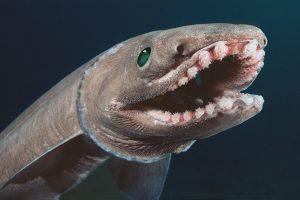 Here's one shark that looks like it just gave up on evolving, feeling pretty happy with its utterly terrifying prehistoric features. The beady green eyes and crinkly brown skin are just some of the features which make this look like a living fossil.
And it also swims like a snake, waving its body through the water until it encounters its favorite prey squid, which it snaps up and often swallows. All its rows of sharp needlelike teeth are ideal for tearing apart softbodied squid, but it will happily eat other fish and sharks if they come close enough.
Finally, the gills have a kind of Frilled shape, which gives the shark its name as well as the look of a 16th century courtier. Well, kind of. These sharks are mysterious and rare, living deep in the ocean, and we know little about them. Our best guess is that they are one of the rarest shark species on Earth, although whether they are endangered is unknown.
Unlike some sharks, the frilled shark gives birth to live young, with the young hatching from their eggs in the mother and then surviving on the yoke for up to 3.5 years, making it one of the longest gestation periods of any vertebrae.
Here's one shark that looks like it just gave up on evolving, feeling pretty happy with its utterly terrifying prehistoric features. The beady green eyes and crinkly brown skin are just some of the features which make this look like a living fossil.
And it also swims like a snake, waving its body through the water until it encounters its favorite prey squid, which it snaps up and often swallows. All its rows of sharp needlelike teeth are ideal for tearing apart softbodied squid, but it will happily eat other fish and sharks if they come close enough.
Finally, the gills have a kind of Frilled shape, which gives the shark its name as well as the look of a 16th century courtier. Well, kind of. These sharks are mysterious and rare, living deep in the ocean, and we know little about them. Our best guess is that they are one of the rarest shark species on Earth, although whether they are endangered is unknown.
Unlike some sharks, the frilled shark gives birth to live young, with the young hatching from their eggs in the mother and then surviving on the yoke for up to 3.5 years, making it one of the longest gestation periods of any vertebrae.
07: Goblin Shark.
 If you've ever seen the old scifi horror movie Alien, you'll know that the most terrifying thing in all of space is the Xenomorph, the eponymous alien of the film designed by Swiss artist H. R. Geiger with one intention to scare the living daylights out of you.
One feature most people remember from the Xenomorph is that when it opens its mouth, another mouth creeps out to finish sucking the brains out of its victim. While you don't have to go to outer space to find such a creature as there's one right here in our oceans the goblin shark.
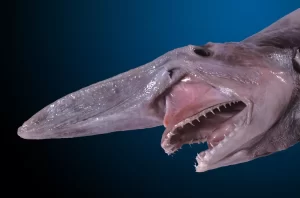
These sharks live down onto the ocean floor, most often in the seas around Japan, and are named for their resemblance to the terrifying goblins of Japanese folklore. They can grow up to 12ft or 4 meters in length and are colored an unusual pink just to add to their charm.
They are extremely rare, and we have only been able to study the few examples which have occasionally shown up in fishing nets. But their most striking feature is their extendable jaw.
They have extra long noses which make detecting prey easier, but at the same time, the little fish and mollusks which form their diet that extra split second to get away before the shark's mouth can react. Except the goblin shark can thrust its jaws out of its mouth to trap its prey in truly horrifying fat. Truly, nature is sometimes just jaw dropping.
Read: What is Li-Fi technology? How does LiFi work? History of LiFi Technology
If you've ever seen the old scifi horror movie Alien, you'll know that the most terrifying thing in all of space is the Xenomorph, the eponymous alien of the film designed by Swiss artist H. R. Geiger with one intention to scare the living daylights out of you.
One feature most people remember from the Xenomorph is that when it opens its mouth, another mouth creeps out to finish sucking the brains out of its victim. While you don't have to go to outer space to find such a creature as there's one right here in our oceans the goblin shark.
These sharks live down onto the ocean floor, most often in the seas around Japan, and are named for their resemblance to the terrifying goblins of Japanese folklore. They can grow up to 12ft or 4 meters in length and are colored an unusual pink just to add to their charm.
They are extremely rare, and we have only been able to study the few examples which have occasionally shown up in fishing nets. But their most striking feature is their extendable jaw.
They have extra long noses which make detecting prey easier, but at the same time, the little fish and mollusks which form their diet that extra split second to get away before the shark's mouth can react. Except the goblin shark can thrust its jaws out of its mouth to trap its prey in truly horrifying fat. Truly, nature is sometimes just jaw dropping.
Read: What is Li-Fi technology? How does LiFi work? History of LiFi Technology
08: Nurse shark.
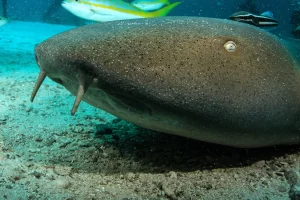 The nurse shark is definitely not the rarest shark on our list. In fact, these sharks remain quite abundant in their natural habitat, which is the bottom of the sea in shallow, warm waters of the eastern Pacific and western Atlantic.
Their names comes from the old English word meaning bottomdwelling shark hearse, which over time became nurse, and they do make a strange sucking sound as they go about their business feeding on the ocean floor. Not unlike that of a nursing baby, they are slowmoving and not particularly dangerous to humans. Although at up to 14ft in length, that's four 2 meters. They are impressive giants.
Some divers have discovered that the smaller ones can even be extremely friendly to humans, stopping to be petted and dropped and seeming to enjoy the attention like the puppy dogs of the ocean floor.
That said, an angry nurse shark will give a diver a pretty nasty bite if it feels like it, so maybe not best to get too friendly. They are prized for their skins, which, being unusually smooth, make high quality leather and the oil produced by their large livers. While under pressure from human activity, we can at least expect nurse sharks to prosper in the wild for some time yet.
The nurse shark is definitely not the rarest shark on our list. In fact, these sharks remain quite abundant in their natural habitat, which is the bottom of the sea in shallow, warm waters of the eastern Pacific and western Atlantic.
Their names comes from the old English word meaning bottomdwelling shark hearse, which over time became nurse, and they do make a strange sucking sound as they go about their business feeding on the ocean floor. Not unlike that of a nursing baby, they are slowmoving and not particularly dangerous to humans. Although at up to 14ft in length, that's four 2 meters. They are impressive giants.
Some divers have discovered that the smaller ones can even be extremely friendly to humans, stopping to be petted and dropped and seeming to enjoy the attention like the puppy dogs of the ocean floor.
That said, an angry nurse shark will give a diver a pretty nasty bite if it feels like it, so maybe not best to get too friendly. They are prized for their skins, which, being unusually smooth, make high quality leather and the oil produced by their large livers. While under pressure from human activity, we can at least expect nurse sharks to prosper in the wild for some time yet.
09: Angular, Roughshark.
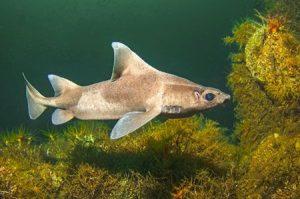 This little shark, which lives down on the muddy seabed off the coasts of Europe and Africa, is both rare and vulnerable, and it looks a little like a tiny sailboat with its large protruding fins, as well as a body which has a kind of triangular shape to it.
Like other bottom dwelling sharks, the angular, rough shark breathes through spiracles behind its eyes. And on this shark they happen to be particularly large, giving these guys a little bit of the crazy eyes look.
Maybe this is the reason behind one of the the myths associated with the angular upshark that it brings bad luck to fishermen for this reason, and that it has no commercial value, fishermen do their best to avoid catching these sharks.
Furthermore, unlike a lot of sharks, even being caught for a short time seems to be fatal. And there are no cases of accidental catches being thrown back and surviving. They were thought to have gone extinct in the Adriatic Sea, but recent sightings have given hope of a comeback. Good news for sharks, but bad news for superstitious fishermen.
This little shark, which lives down on the muddy seabed off the coasts of Europe and Africa, is both rare and vulnerable, and it looks a little like a tiny sailboat with its large protruding fins, as well as a body which has a kind of triangular shape to it.
Like other bottom dwelling sharks, the angular, rough shark breathes through spiracles behind its eyes. And on this shark they happen to be particularly large, giving these guys a little bit of the crazy eyes look.
Maybe this is the reason behind one of the the myths associated with the angular upshark that it brings bad luck to fishermen for this reason, and that it has no commercial value, fishermen do their best to avoid catching these sharks.
Furthermore, unlike a lot of sharks, even being caught for a short time seems to be fatal. And there are no cases of accidental catches being thrown back and surviving. They were thought to have gone extinct in the Adriatic Sea, but recent sightings have given hope of a comeback. Good news for sharks, but bad news for superstitious fishermen.
10: Thresher shark.
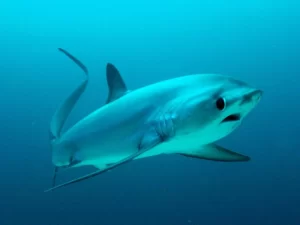 The Thresher shark is one of the most fascinating species of shark in our oceans. A close relative of the great white shark, this species has one very distinctive feature it's enormous tail.
The tail on a thresher shark can be almost as long as the shark itself. And one of its benefits is that it gives this species a huge speed advantage, making it one of the fastest sharks in the sea. Capable of swimming at speeds up to 30 mph or 50 km h.
The name Thresher comes from the farming tools that resemble the huge shark tails, and it was long assumed that the tails were used for hunting. But it was not until 2010 that the technique was finally observed. It had been believed thresher sharks lashed the tail from side to side to stun prey like sardines.
But in fact, the shark arrives in a shoal at huge speed, then uses its fins to slam on the brakes before launching the tail over its head like a huge whip, killing and stunning several fish at once, which can be eaten at leisure. And you thought it was the front of the shark you had to watch out for.
Thresher sharks are one of the rare species of sharks that have warm blood, which gives them extra speed and agility, and they have a long history with humans. First described by Aristotle and ancient Greece, they have been at the center of many myths and folklore traditions of the sea. Watch out for that scorpionlike tale, though.
The Thresher shark is one of the most fascinating species of shark in our oceans. A close relative of the great white shark, this species has one very distinctive feature it's enormous tail.
The tail on a thresher shark can be almost as long as the shark itself. And one of its benefits is that it gives this species a huge speed advantage, making it one of the fastest sharks in the sea. Capable of swimming at speeds up to 30 mph or 50 km h.
The name Thresher comes from the farming tools that resemble the huge shark tails, and it was long assumed that the tails were used for hunting. But it was not until 2010 that the technique was finally observed. It had been believed thresher sharks lashed the tail from side to side to stun prey like sardines.
But in fact, the shark arrives in a shoal at huge speed, then uses its fins to slam on the brakes before launching the tail over its head like a huge whip, killing and stunning several fish at once, which can be eaten at leisure. And you thought it was the front of the shark you had to watch out for.
Thresher sharks are one of the rare species of sharks that have warm blood, which gives them extra speed and agility, and they have a long history with humans. First described by Aristotle and ancient Greece, they have been at the center of many myths and folklore traditions of the sea. Watch out for that scorpionlike tale, though.
11: Hammerhead Shark.
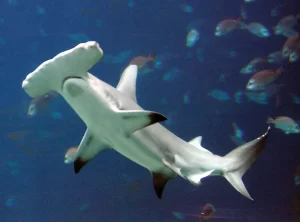 Hammerhead Shark one of the most recognizable sharks in our oceans is the charismatic hammerhead shark, with its enormous hammershaped head. There are in fact ten different species of hammerhead, with the biggest being the great hammerhead, which can grow up to 18ft or five points meters and weigh in at one £0 or 450 kilos.
The chances of meeting one of these monsters are slim, though, as the great hammerhead is in danger of extinction.
Being overfished forts fins which are eaten as soup in some parts of the world. The hammerhead shape gives the shark a hunting advantage, it is believed, as it allows the shark to carry more of the cells that allow it to sense the electromagnetic fields of its prey, giving it far better electromagnetic vision than other species.
These sharks are also known to spend a lot of their time swimming sideways, which allows for more efficient swimming. And one species is the only omnivore shark known to science, enjoying seaweed snacks along with its main diet of meat. Finally, these sharks get tanned from the sun and seem to have properties in their skin which resist cancer, helping us to understand skin cancer better.
Read: Here are some great computer hacking tips for your windows.
Hammerhead Shark one of the most recognizable sharks in our oceans is the charismatic hammerhead shark, with its enormous hammershaped head. There are in fact ten different species of hammerhead, with the biggest being the great hammerhead, which can grow up to 18ft or five points meters and weigh in at one £0 or 450 kilos.
The chances of meeting one of these monsters are slim, though, as the great hammerhead is in danger of extinction.
Being overfished forts fins which are eaten as soup in some parts of the world. The hammerhead shape gives the shark a hunting advantage, it is believed, as it allows the shark to carry more of the cells that allow it to sense the electromagnetic fields of its prey, giving it far better electromagnetic vision than other species.
These sharks are also known to spend a lot of their time swimming sideways, which allows for more efficient swimming. And one species is the only omnivore shark known to science, enjoying seaweed snacks along with its main diet of meat. Finally, these sharks get tanned from the sun and seem to have properties in their skin which resist cancer, helping us to understand skin cancer better.
Read: Here are some great computer hacking tips for your windows.
12: The angel shark.
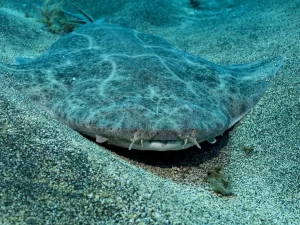 Another incredible species of shark four angel shark. The angel shark is like no other shark. In fact, it's easily mistaken for a ray. Due to its flat body. These bottom feeders prefer to lurk beneath the sandy seabed, waiting for unsuspecting prey to come just that little bit too close before their incredible strike speed sees them shoot out of COVID at a 90 degree angle to grab their meal in a jaw full of sharp teeth.
Most sharks have to constantly move to be able to breathe, allowing the water to flow through their bodies to get enough oxygen in. But the angel shark hunting style means it spends a lot of time lying still, so it has spiracles on the top of its head which pump water through its body, allowing it to breathe while motionless.
These sharks there are in fact 15 species of angel shark like to live near coral reefs in the oceans surrounding the Americas. And luckily, most of the nations in North America have now banned the fishing of this near endangered species. So we can hope to see a recovery of the angel shark, sometimes paradoxically known as a sand devil. Population angel or devil, that can only be good news.
Another incredible species of shark four angel shark. The angel shark is like no other shark. In fact, it's easily mistaken for a ray. Due to its flat body. These bottom feeders prefer to lurk beneath the sandy seabed, waiting for unsuspecting prey to come just that little bit too close before their incredible strike speed sees them shoot out of COVID at a 90 degree angle to grab their meal in a jaw full of sharp teeth.
Most sharks have to constantly move to be able to breathe, allowing the water to flow through their bodies to get enough oxygen in. But the angel shark hunting style means it spends a lot of time lying still, so it has spiracles on the top of its head which pump water through its body, allowing it to breathe while motionless.
These sharks there are in fact 15 species of angel shark like to live near coral reefs in the oceans surrounding the Americas. And luckily, most of the nations in North America have now banned the fishing of this near endangered species. So we can hope to see a recovery of the angel shark, sometimes paradoxically known as a sand devil. Population angel or devil, that can only be good news.
13: Horn shark.
The horn shark, as you might have guessed from its name, has a pretty unusual appearance, with its most prominent feature being two rigid horns over each of its eyes. They also have two spines sticking out from their backs, kind of like an old TV antennae. These small sharks live off the Pacific coast of North America and have a somewhat lazy air about them. They don't like to swim much, preferring to shuffle along the seabed pushed by their fins. And in fact, the longest recorded distance a horn shark has been known to travel is about 10 miles, or 16 km. They might have called this the sloth shark. However, they are still predators and know how to catch a meal when they need one, and they largely hunt at night. But they too are sometimes the hunted and our friend, the angel. Shark has been observed attempting to eat a horn shark only to spit it out after getting a nasty sting from one of the spines. So, being popular off the coast of Mexico, you might say this is one hot and spicy shark.14: Basking shark.
 Basking shark is the second biggest shark in the oceans, after the whale shark, and this giant can be found in warm, temperate coastal waters all over the world. Basking sharks are plankton eaters, just like their whale shark cousins, and they glide through the ocean with that huge mouth wide open to filter out the tiny sea creatures as they pass through.
These sharks have figured in the mythology of many countries, especially Britain and Japan, and this tradition has included even recent myth creations where the rotten carcasses of basking sharks known as globsters washing up on British and Japanese beaches have been believed to be those of ancient placiosaur or sea monsters unknown to humanity.
Furthermore, these slowmoving and nonaggressive sharks have long been popular sources of oil, food and leather, but the species is now endangered and protected in many countries.
The basking shark might also have been popular with fishermen due to having the smallest size to brain ratio of any shark, meaning they're probably a little on the slow witted side, certainly not the Einstein of the shark world.
The smallest shark out there? Well, it's one that the basking shark is sometimes mistaken for the great white shark.
Read : How do Computer Hackers hack other people’s information?
Basking shark is the second biggest shark in the oceans, after the whale shark, and this giant can be found in warm, temperate coastal waters all over the world. Basking sharks are plankton eaters, just like their whale shark cousins, and they glide through the ocean with that huge mouth wide open to filter out the tiny sea creatures as they pass through.
These sharks have figured in the mythology of many countries, especially Britain and Japan, and this tradition has included even recent myth creations where the rotten carcasses of basking sharks known as globsters washing up on British and Japanese beaches have been believed to be those of ancient placiosaur or sea monsters unknown to humanity.
Furthermore, these slowmoving and nonaggressive sharks have long been popular sources of oil, food and leather, but the species is now endangered and protected in many countries.
The basking shark might also have been popular with fishermen due to having the smallest size to brain ratio of any shark, meaning they're probably a little on the slow witted side, certainly not the Einstein of the shark world.
The smallest shark out there? Well, it's one that the basking shark is sometimes mistaken for the great white shark.
Read : How do Computer Hackers hack other people’s information?
15: Saw shark.
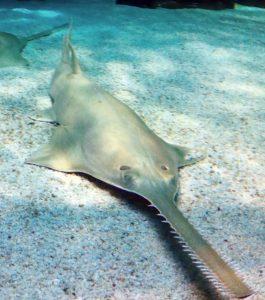 Back on the list of crazy looking sharks that might belong in some kind of weird underwater carpentry kit along with the hammerhead, we have the saw shark.
This shark looks like it was designed by a high school kid with a vivid imagination, but it is 100% real and living out there in the Indian and Pacific Oceans, there are, in fact now eight different species of saw shark recognized by science, with the most recent discovery coming in 2014 when a new species was identified near the Philippines.
These strangelooking creatures have their teeth protruding all along a flattened snout, which can make up almost onequarter of their body length. The snouts are used for hunting and defense, as well as helping the sharks to detect electromagnetic signals coming from their prey.
They pick up a signal and then use their snouts to dig up food from under the sandy seabed before song them to death and then eating whatever poor unfortunate mollusk happened to be sleeping there. Although they look terrifying, they are not considered dangerous to humans, mainly because they live so far from us and are extremely rare animals.
There's only one fatal saw shark attack on record. Although rare, luckily these sharks are not considered under threat from humans living far away from our fishing areas. Which of these sharks do you think was the most incredible? What kind of random masonry tool type shark head do you think evolution will throw up next? Let us know in the comments below.
Also, Thanks for reading.
Follow Us on Facebook & See our videos on YouTube
Back on the list of crazy looking sharks that might belong in some kind of weird underwater carpentry kit along with the hammerhead, we have the saw shark.
This shark looks like it was designed by a high school kid with a vivid imagination, but it is 100% real and living out there in the Indian and Pacific Oceans, there are, in fact now eight different species of saw shark recognized by science, with the most recent discovery coming in 2014 when a new species was identified near the Philippines.
These strangelooking creatures have their teeth protruding all along a flattened snout, which can make up almost onequarter of their body length. The snouts are used for hunting and defense, as well as helping the sharks to detect electromagnetic signals coming from their prey.
They pick up a signal and then use their snouts to dig up food from under the sandy seabed before song them to death and then eating whatever poor unfortunate mollusk happened to be sleeping there. Although they look terrifying, they are not considered dangerous to humans, mainly because they live so far from us and are extremely rare animals.
There's only one fatal saw shark attack on record. Although rare, luckily these sharks are not considered under threat from humans living far away from our fishing areas. Which of these sharks do you think was the most incredible? What kind of random masonry tool type shark head do you think evolution will throw up next? Let us know in the comments below.
Also, Thanks for reading.
Follow Us on Facebook & See our videos on YouTube
How to make the most of the time of day in an easy way?
How To Create More Time, Some Ways to Add More Hours to the Day. Let's Check It Out.
Today I will give the dialogue of the movie. There is an English word in South India - Rowdy. This is almost unheard of in England and America. This word means - rowdy, hooligan, etc.
Dialogue from that movie, translated into English, reads like this:
To live a hundred years, it will not take a hundred years. Do something in one day, so that people remember you for a hundred years.
Yes, this is the best way to use time. Do something that people remember. Just one job, to be done so well, that people remember it for hundreds of years.
Let's see how long it takes to do a job well.
- Steve Jobs, the founder of the Apple company, and creator of the iPhone lived to be only 56 years old.
- The most famous modern star, Michael Jackson lived only 53 years.
- Bruce Lee's name comes to mind when talking about kung fu karate, etc. He died of illness at the age of 32.
History has seen such famous people. Now look at the living people
- Google founder Larry is 49 years old.
- Facebook founder Mark is 37 years old
- QUORA founder Adam is 37 years old
It turns out, the way to make the most of time is to do something, and do it so well, that people will remember you for ages.
Now let's find out easy ways to find more time in a day!
Most of us struggle to find an extra minute or two in our day for anything. With today’s fast-paced lifestyles, things like spending time with family and resting can often fall by the wayside. But even with a mountain of responsibilities, sneaky time-saving tricks still exist that help you create more time for the things that really matter. Here are a few simple time-saving tips that you can start practicing today, and thank us for later.Make some schedules.
Just because you can technically fit it into your schedule doesn't mean you always should. How many chores your kids are allowed to do after school, how many evenings a week you want to go out, how many committees you're comfortable joining right now - set a limit before all the initiations and requests flood in. In a busy life, if things aren't scheduled, they often don't happen. So schedule doing nothing as a time to rest and relax. Treat that time like any other planned activity you commit to and stick to it. While kids want to do many after-school activities and it can be challenging to say no, spending quality time with family and keeping calm, healthy parents is just as important as developing athletic and creative skills and hobbies.Have a plan, and stick to it.
Keep a weekly list of common tasks. Whether it's admin, cleaning, or chores, (or all three!) having regular weekly allocations for specific tasks will help get them done as well as ensure things never get too busy. For example, mark Monday as banking and laundry day, and Tuesday as filing and grocery shopping day.Identify your personal "productivity prime time".
We all have a certain time of our day when we are most efficient. (For most people, that's between 8 a.m. and 11:30 a.m., but that's not necessarily the case for you.) Use these hours for the most challenging tasks you have to do that day. If you're a stay-at-home mom, it could be your child's nap time or TV time.Get ready as soon as you wake up.
Make your "to-do" list the night before so that when you wake up the next day, you can get cracking right away. This will encourage productivity and a sense of accomplishment early in the day – which will help keep you motivated.Reduce Travel Time.
One of the top five common traits shared by the world's happiest people is that they live close to work As a result, they have more free time to spend on the things that matter to them rather than spending an extra two hours a day sitting in traffic. Whether it's for school or work or dropping the kids off at their daily activities, take a look at what your daily routine is and see where you can spend less time spent traveling. While two hours a day, or even 1 hour, may not seem like much, it's a daily occurrence, and it adds up fast. A two-hour commute a day adds up to ten hours a week and about 43 hours a month. That's about two full days a month spent commuting—the equivalent of an extra weekend. How happy would you be if you enjoyed one extra weekend every month?Learn to love the word "No":
As clichéd as it is, it's equally true – especially for full-time mothers. Just because people ask you to run errands for them, watch their kids, volunteer, host events, and/or anything and everything else, doesn't mean you have to say yes! This brings us directly to the tip; "Schedule something". When your "do nothing" time and your planned activities have maxed out all the space on your calendar, you have no time left to agree to anything else. That's not to say it's never going to be an option, but you should wait until there's time in your schedule for it. This will help you manage any potential feelings of guilt, while again avoiding falling into the "over-committed" trap.Bonuses:
As I write on Islamic subjects, I have little acquaintance with some. They will be a bit disappointed. Because, in this article, only media-related people are mentioned. For those readers……
Bukhari Hadith Collection Complete Book, Write All Volumes. How to write? Write down each line carefully. See how long it takes. It will take a few years. Now imagine, there is no such thing as a Bukhari hadith collection. You will write such a hadith collection yourself. How to write? Collect hadiths from different people. If so, how many years will it take to collect and write so many hadiths? It may take 70-80 years. Now imagine, the internet, mobile, etc. were not invented. How many years will it take to collect and write so many hadiths? If there are no cars, planes, etc., how many years will it take to order from different places? Muhammad Bukhari, the author of the Bukhari Hadith Collection, was born in 810. There was nothing at that time. Such an extensive collection, collected and written in that era, should take 700-800 years to complete. Muhammad Bukhari lived for 60 years.Muhammad Bukhari's words have to be explained. However, nothing should be implied about the prophet Hazrat Muhammad (PBUH) because you all know. What Prophet Muhammad (PBUH) did in just 23 years, people like us will not be able to do in a thousand years.
All this is possible - because of Allah's blessings and mercy. The media persons I mentioned, though non-Muslims have been blessed by Allah. That's why they can do it. You also pray. Repeatedly pray to Allah for blessings and mercy. By God's grace, you too can do such a wonderful thing.
Thank you, If you learned something new then please share it with your friends and family. Also, Follow Us on Facebook & See our videos on YouTubeWhat is Li-Fi technology? How does LiFi work? History of LiFi Technology,
Li-fi and Wi-fi are not the same things. Many people make the same mistake. Internet that is available through Light is called Li-fi. In today's episode we will discuss what is Li-fi, history of Li-fi, how it works, benefits of Li-fi, when will Li-fi come, and Wi-fi Vs Li-fi. Make our writing worthwhile from the end.
Li-fi's full-form Light-Fidelity. Li-Fi is a wireless optical networking technology that transmits data through lights. It is supposed to be 100 times faster than Wi-Fi. But still, the actual speed is not sure. Dramas, songs, etc will be downloaded in a blink of an eye on Li-Fi.
We know that we get an internet connection through light. The Wi-Fi we use today is transmitted through optical fiberglass, reducing the speed by about 40%. On the other hand, Li-fi can be used through household lamps. So wi-fi is considered to be nothing in front of the speed of li-fi.
History of LiFi Technology:
Professor Harald Hasch of Edinburgh University is the inventor of Li-fi. He first unveiled and introduced Li-Fi in 2011. He showed everyone how to communicate with a light. After the test results of Li-fi vs Wi-fi, li-fi was found to be much faster than wi-fi.
He then joined a company to further develop Li-Fi. And that company is called PURELIFI. Although many companies are currently working on li-fi.
How does LiFi work?
We first give an example with TV and remote. Then you will understand. When we give a signal to the TV with the remote, the channel of the TV changes. But why is this? Let's find out.
We have seen that there is a light attached to the front of the TV remote. Also called an infrared bulb. Then, when you press a button on the remote, the specific signal on the remote lights up. Seeing the light from the remote, the sensor on the front of the TV understands it and works accordingly.
Suppose, to change the TV channel, if the light on the remote blinks twice, the channel changes. That is, whenever the remote is pressed, different signals are sent to the TV. And the TV understands the remote signal because the TV is pre-programmed.
Our li-fi technology is very much like that. But our TV remote has only one bulb installed. But Li-Fi will have lots of bulbs installed so that data transfer is faster and many people can use it simultaneously. Now let's come to work.
First, the internet will come to your router from the li-fi Net server. Then the data will be transferred from the router to the light or bulb and you will get the service from there.
If I want to say in the language of the book, then I will say that the light from the LED bulb captures data at frequencies. And the data is exchanged, through LiFi-supported devices. Then a PhotoSensitive Detector converts the light frequencies into signals and converts them into electronic data systems. And that's how Li-Fi works.
Although the technology is only being used in industrial applications, it will soon make its way into smart homes. It is predicted that future home and building automation will continue to rely on LiFi to be fast and secure.
Advantages of LiFi (Lifi vs Wifi):
From what we have known so far, we may have known about the benefits of fast speed. Now let's know about some more benefits.
1. The first advantage we already know is its great speed. On Li-Fi you can get speeds up to around 100 GBPS. Also, Li-fi has 10,000 times more frequency than Wi-fi.
2. Since Li-fi has a higher frequency, many people can use it simultaneously. But when the number of users on Wi-fi is high, the net becomes slow. So Li-Fi will be the best technology for network sharing.
3. Li-fi connects through room lights, so only you get that data when your room lights are on. No one outside the house can use the Li-fi you bought with your money. And no one will know that you are running Li-Fi. On the other hand, if you run wifi, it goes out through the wall and others connect if you know the password. As a result wifi speed decreases.
4. Since Li-fi runs on light, you can direct it towards you. As a result, there will be no signal loss and the speed of data exchange will increase. On the other hand, the Wi-Fi signal spreads around and causes a lot of loss. And you don't get real speed either. So Li-Fi will be the latest benchmark of internet speed.
5. There are many places where radio or wireless signals are prohibited. There also you this technology
can use Because it doesn't need wireless to use it. For example – A wireless signal or network is turned off in various factories. Because many times there is a danger of accident from the net signal. Again, the network is not available on the plane. So you can use LiFi even there if you want.
And the most interesting thing is that you can use Li-Fi even under deep clear water. Because we know that normal wireless signals don't work underwater, but light signals do.
When you use Li-Fi, you will see many more benefits. Because using it gives a real idea about a thing. Let's demystify some Li-Fi myths. Maybe you also believe in this rumor. Let's put the rumors to rest.
6. Another big advantage of LiFi is that the use of solar allows LiFi connections to happen almost instantaneously because light travels at such a high speed. This leads to faster transmission of knowledge and faster internet connections – about 100 times faster than speeds achievable by WiFi.
Misconceptions about Lifi:
1. Many of us know that LiFi will be 100 times faster than WiFi. But to me, it seems like a rumor. Because of the wi-fi we use, the latest technology can provide speeds up to 700 GBPS. Such speeds have not yet been found in LiFe's experiments. So LiFi will never be 100 times faster than Wi-Fi. Maybe through research, it can be 2x faster shortly.
2. Movies or large files will download in 1/2 second on li-fi, it's not that realistic. because We currently hear about 700 Gbps internet speed of wifi. But service providers doubt whether we can get a maximum of 100 Mbps from our line. And Li-Fi how do you expect so much speed? Maybe this speed will be officially applied for some big work.
Where is Li-Fi technology used?
Li-Fi technology is widely used in various applications such as healthcare, education, retail, aviation, exhibition industry, etc. . Healthcare is one of the primary application areas within the global Li-Fi market. Hospitals have always received technology in the form of wired connections.
Mar 6, 2019. Indonesia is among the first countries to power LiFi in a primary education center. Eindhoven, The Netherlands - Global lighting leader Signify (Euronext: LIGHT) has announced that it is working with around 30 customers in Europe, North America, and Asia to launch its commercial LiFi system.
Is Li-Fi technology harmful?
In contrast, LiFi transmits data through light waves in the spectrum, so is completely free from harmful radio-frequency radiations. Similarly, LiFi technology is often used in environments where WiFi is considered a threat.
Can LiFi be hacked?
Li-Fi uses visible light. ... Li-Fi works on existing protocols and unlike Wi-Fi does not require routers or hotspots. It can transmit data at much higher speeds than conventional Wi-Fi systems. Furthermore, since light cannot pass through walls, it is thought that Li-Fi signals cannot be easily hacked.
Can LiFi replace WiFi?
In line with WirelessSquare, Leaf-E, the use of solar energy to provide a wireless Internet connection, could become the most common source of communication in buildings within the next 10 years. Basically, it will be a game-changer, using LED lights to create WiFi.
What is the cost of LiFi?
The lamp costs around $841 and comes with a dongle. Only a single person can use the lamp at a time (multiple user support is due later this year), so you can't buy extra dongles.
When will Li-Fi technology come?
Already, various big IT organizations have started working using LiFi. Also to use Li-Fi you need to buy Li-Fi supported mobile. Renowned mobile manufacturing companies are working towards making mobiles Li-Fi supported.
As some companies continue to work with Li-Fi technology, it is assumed that LiFi will be used in 2022. No word on pricing.
Last word: You don't have to worry about Li-fi. Because our phone is not Li-Fi supported. If anyone buys a Li-Fi-supported phone, then come and tell the speed in the comment box, Inshallah.
Thank you, Follow Us on Facebook & See our videos on YouTube